
AI / TFI / BCAFC
A.1
…and what we are calling Artificial Intelligence at the moment is really a type of Theory Free Inferencing which has had greater than expected returns.
Artificial Intelligence is a broad term, and one which has been used to describe a number of things, but traditionally it has meant writing a program which can approximate what a person would do in a given situation. If you have turned on AI Bots in a Call of Duty then what is happening is a program is running which has an understanding of the world it is in and what it needs to do in that world and it does those things.
Shoot, don’t get shot, take cover, claim objectives, retreat from a greater number of foes, attack when you are in the majority. Those things we will call the theory.
A.2
That is not how ChatGPT, or Gemini, or OpenAI work, or other Theory Free Inferencing machines work. They are “a data-driven approach where decisions or predictions are made using statistical correlations without needing an underlying causal model or explanation of how the world works”
Rather, they have no theory, and that is a benefit. They are word guessing machines and it turns out that human beings, on the whole, are more predictable than was generally thought. When you understand all the conversations which have ever happened, probably, the next conversation that happens will follow the same form as that.
Which is great, in theory, that humanity has invented a machine which will guess the next word that you will probably say to your wife in your next conversation. “Hi Honey, I’m home…” and so on, but if she starts off that conversation with “I want a divorce” then the probability based generalities are useless against the requirement to be entirely based in specifics.
A.3
Play enough games of Chess against ChatGPT and you will find at some point it puts the Queen onto a space where it has a Knight. For years Artificial Intelligence played Garry Kasparov the Chess Grandmaster and lost.
When a machine finally beat Kasparov it was not that a machine had been taught to think better than a human, it is that a Chess Winning Machine had been written.
That machine – Deep Blue – had a theory. It had the rules of Chess and every match ever recorded plugged into it but it was only really intelligent in the same way that a Submarine swims. The output of intelligence, we have decided, is winning Chess matches, so something which wins chess matches must be intelligent.
B.1
Graham Alexander’s Bradford City have started the 2026/2027 season off in good form. On the morning before playing Leyton Orient for a place in the last sixteen of the League Cup City sit fourth in League One having beaten leaders Sheffield Wednesday in a very impressive second game, but slipped to defeats at Plymouth away and Cambridge at home.
Other wins against Mansfield, Peterborough and in the League Cup, Rochdale, are also of note while the penalties victory over Burnley seemed to be a minor landmark.
Given these results as an output the input to City has been in the club once again being competitive in the transfer market. As summer arrived players were signed and signed early with the knowledge that Jenson Metcalfe would be joining Millwall all suggesting that the Bantams are largely in rude enough financial health that the money generated on the field in sales can be returned to the field.
B.2
With that has come a change of style in how the Bantams play. Twelve months ago when Day One Stephen Humphrys was terrorising defences Graham Alexander was a manager committed to the idea of controlled attacking possession. The ball came forward in methodical, systematised movements with players running in possession and wonder passes played towards the corners for Humphrys to retain and return to the on running second row of attacking players.
The elusiveness of Humphrys asked questions of defences which the division eventually solved and by the end of November no central defender was being tempted to follow Humphrys past a full back leaving an acre for Bobby Pointon to run into. Alexander evolved the system and the Bantams ended the season playing long diagonal passes behind the opposition’s left back for Josh Neufville to head back. No attempt to maintain control of the ball, but a practical solution to the problem at hand.
Signing Jake Beesley is codifying that approach to control. The purpose of Beesley in the Bradford City team is not to have the controlled possession which Humphrys had, it is to create an element of chaos when the ball comes forward to allow the attacking midfield to benefit from that chaos rather than having to craft more controlled chances.
B.3
In the final weeks of Bradford City’s season when playing Bolton Wanderers became common it seemed obvious that the Bantams had settled into a correct position in the league. City were a little worse than Bolton Wanderers, but only a little. City could go toe to toe with The Trotters and probably get a draw, but the odd goal would go to the team west, and so the challenge is how do the Bantams score more goals.
The chaos of a more direct game to a target man resulting in less controlled possession is the answer. Alexander wants City games to have one more goal in them, and wants City to score that goal. He is attempting to increase the number of interesting events in a Bradford City game. Add another dice to the roll, and he believes that Bradford City will be the beneficiaries of that increased uncertainty.
Against Cambridge United though, the chaos benefitted the visitors. A counter attack here, an odd goal there and City end up getting booed off for carrying out – on the whole – exactly the ideas which the manager believes will win promotion. The ideas which have brought wins over Sheffield Wednesday and Burnley. The ideas which the entire club has positioned itself to enact.
That is the theory. Getting booed off, for that.
C.1
When you ask a Theory Free Inferencing Large Language Model what football fans do when their team loses it gives you a long list. Read it and you can find yourself on it.
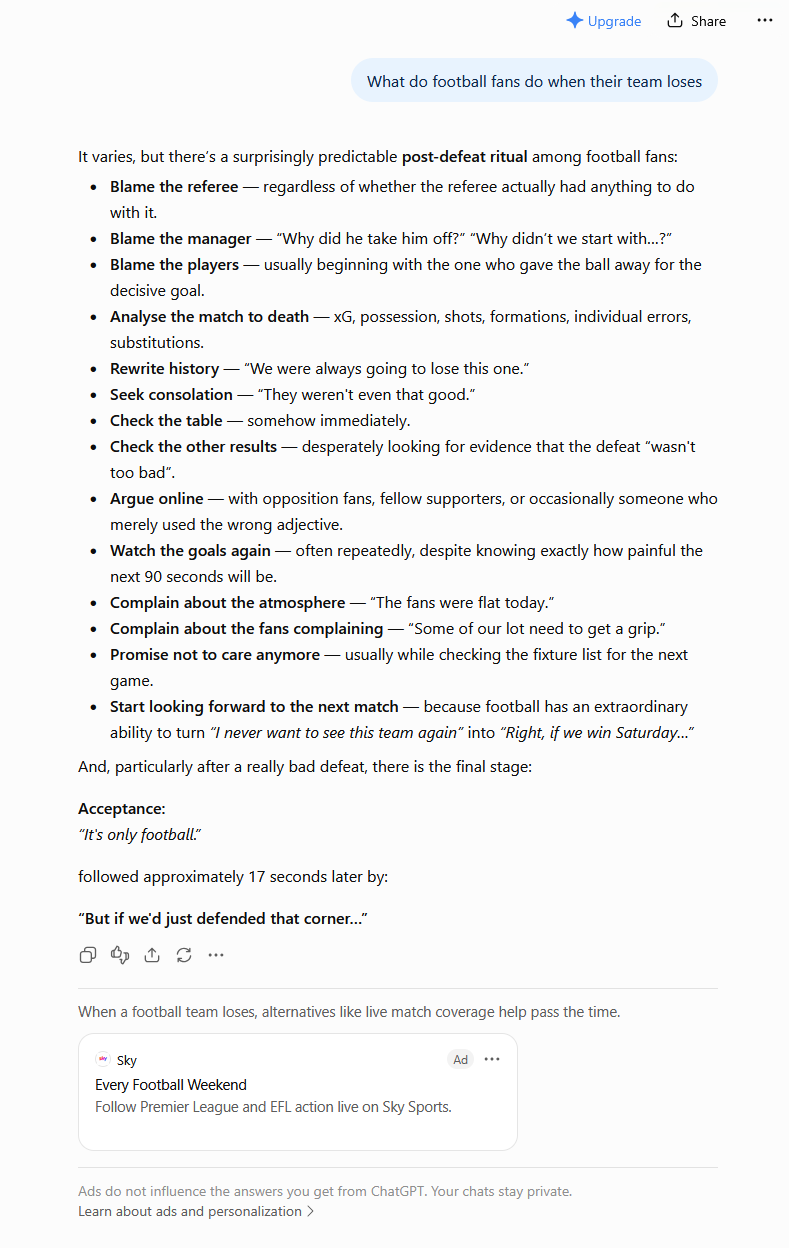
It is a fairly tedious read to be honest, the kind of set of cliches a screenwriter with no experience of following the game might come up with, something which makes caricatures out of people.
This is not to say anything definitive about if a person’s reactions are or are not on an arbitrary created list from a TFILLM but rather that much of the criticism of Bradford City in September 2026 seems to share an ignorance of that theory which underpins the club at present.
C.2
The criticism which Bradford City fans is always a curious mix and there is often a mismatch between the volume of the commentator and the number of people making that sound, and that often this is in inverse proportion.
The louder someone is, the more isolated their position, while common positions are spoken softer but combined the volume rises to the same level. None of these are correlated to veracity.
Nevertheless to sum up: City are less interesting than they were, the criticism goes, and they are less able to win games, and the individual purchases are poor, specifically the aforementioned Beesley.
C.3
Having watched Bradford City ascend League One with Humphrys and a way of playing that ensured control, and having seen the counters to that control nullifying Humphrys, and Alexander change that team in December with the signings of Paul Mullin and Ethan Wheatley, then pivot from that pivot to wards the long passing towards Neufville and other which saw City finalise into fourth position Alexander’s solutions, which might not be mine, are not a mystery.
That Alexander has come up with a way to advance Bradford City is – and should always be – the subject of some discussion. If talking about football is anything it is talking about how the agents of a club are attempting to achieve the goals set out. It is good to ask what Graham Alexander is doing to make Bradford City better this season than last, and of those approaches will work in the term laid out.
However, watching those agents attempting to enact a solution and drawing a conclusion in short order suggests a detachment from that solution, which is to say, not understanding the theory which underpins what is happening on the field.
C.4
That theory is starkly obvious. That Bradford City circa the 2020s plan to increase turnover in order to create as large a financial advantage for the management team to spend on players having put a trusted management team in place.
That by distributing the expertise around a management team: Graham Alexander, David Sharpe, Stephen Gent and on; to ensure that that money is spent effectively with that recruitment team believing that value can be found in mostly senior professionals, although that prevalence of senior professionals creates a development environment for a hand full of young players to thrive in.
That then is reflected on the field by football mature players able to enact the roles Alexander has laid out for them and, crucially, to enact changes in those roles as the manager believes. Graham Alexander has not had to explain to Antoni Sarcevic what to do in his new position and hope the player understands in the way the manager would have to do with a raw player.
That is the current theory of Bradford City, laid out as unvarnished as it can be. What then is the virtue of – knowing that – vocalising against it as if one is unaware that theory exists.
D
Talking about a football club is underpinned by what the club is trying to do because without that we can only speak in cliche phrases drawn on historic events which have been only connected by coincidence.
Bradford City are at the start of enacting something which may – or may not – work and that is an interesting thing to discuss, but it is tedious when abstracted out of the context which the club is in.
- Earlier 2 months ago Thursday 13th August 2026 Before the start of the 2026/27 League One Season. Season / Evolve / Outcomes Having missed out on promotion to in 2025/26 Graham Alexander has evolved how he wants his Bradford City team to play to a midfield-lite system which the defensive unit use new target man Jake Beesley as a pivot point for lengthy passes which the intense attacking line look to benefit from. It will either work, or not, or somewhere in the middle.
- Earlier 27 days ago Monday 28th September 2026 After Graham Alexander left to become Preston North End manager. Cteh / Gangs / City As the football world digests the scale of Manchester City being found guilty of most of the 115 charges they face, Preston North End approach and hire Bradford City's Graham Alexander to be their new manager leaving the Bantams knowing what they need from a new number one.